For lifestyle houses, brands and design rooms
It knows what the garment is. The picture comes after.
Any image tool will draw you a lehenga. Ask most of them for a chaniya choli and you will get a lehenga too — because the chaniya choli is rarer, and a model reads silence as licence to fall back on what it has seen most of.
ZZEESS is not a prompt box with a fashion skin. It is a described catalogue — garments, crafts, cuts, cloths, occasions, regions, and how each of them looks — and the render is composed from that catalogue rather than from a sentence somebody typed.
Fashion is the major part of it and the hardest case, which is why it is the one everything else was proved on. It is not the extent of it: 130 of the 289 things this catalogue describes are not apparel at all. A leather-goods house, a jewellery house and a footwear brand are reading about their own work here, costed on their own baselines rather than on a garment’s.
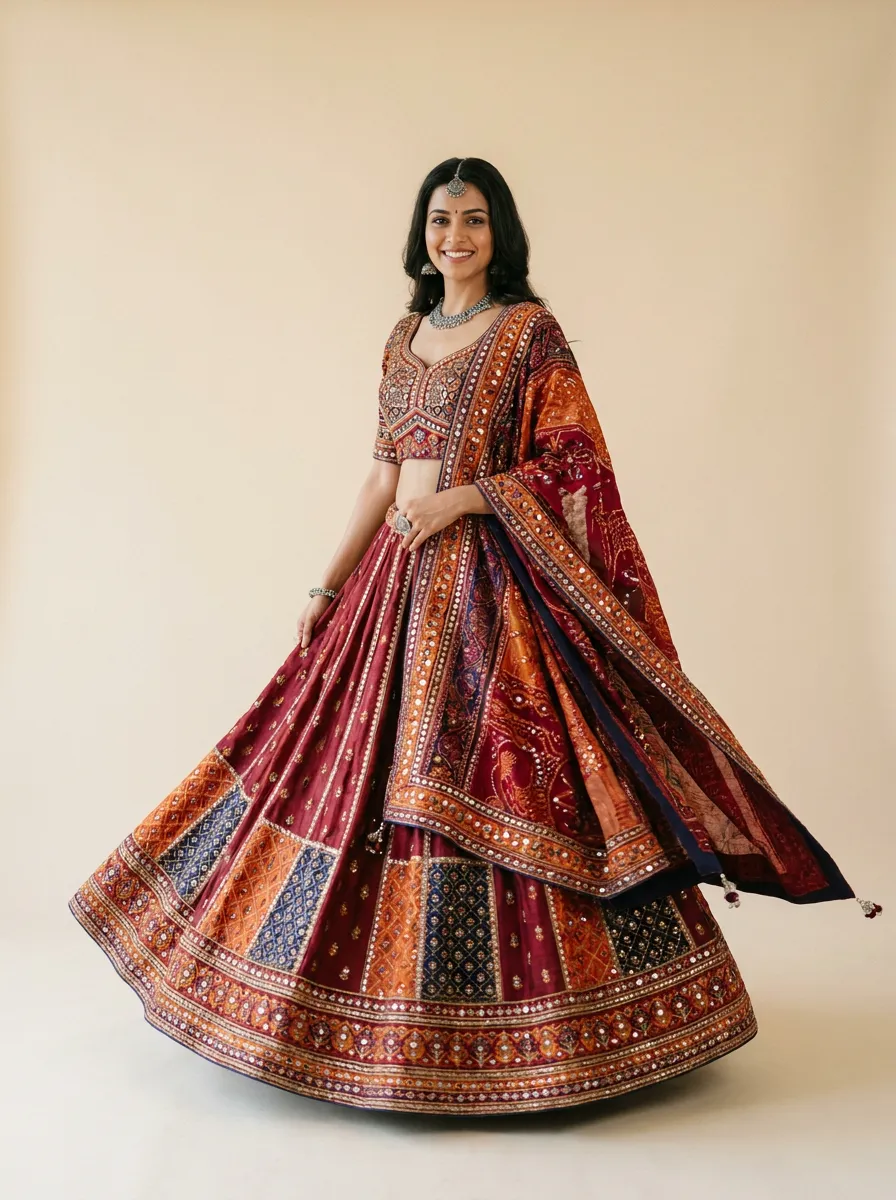
We will start with the four that came back wrong
Four navratri chaniya cholis were rendered on the most capable model configured, from a brief that named the garment, the occasion, Gujarat, and mirror work. They came back as maroon-and-gold bridal lehengas. One wore its dupatta as a saree pallu; one wore it as a bridal veil; none of the four had a single mirror on it.
The catalogue held the right words the whole time. The garment’s own note describes the bands above the hem and the cropped choli; mirror work’s note describes the mirrors down to the ring of stitches around each one. Both were in the prompt. Both lost — to ten later clauses, and to the model’s prior that Indian occasion wear is a bridal lehenga.
Worse: those four were tagged with mirror work, priced on it, matched to makers on it, and filed in the library. Nothing in the platform noticed. A person did, a day later, by looking.
Most of what is described on these pages was built in the weeks after that, and each piece of it is the answer to one specific way a render goes wrong.
Four things that are true here
A garment carries its own vocabulary
A brief that names no craft used to fall through to one default for a whole market — “fine hand embroidery”, handed identically to a navratri chaniya choli, a Kanjeevaram bridal saree and a Kutchi kediyu. A chaniya choli now carries mirror work, bandhani and gota patti, because those are what make garba dress read as garba dress.
A lehenga deliberately carries none. It is zardozi in Delhi, gota in Jaipur and thread in Surat, and picking one would be inventing a fact and then rendering it a thousand times.
A region works a craft differently
Delhi builds zardozi in high relief, thick enough to catch light from the side. Surat lays the same metal flat, in fine open lines with the ground cloth showing through. They read as different crafts in a photograph, and the catalogue used to hold one sentence for both.
A regional manner says how a chosen craft is worked. It is never allowed to say what — a test scans every row to make sure none has smuggled in an ingredient nobody asked for.
Cut is a dimension, not an adjective
Neckline, sleeve, collar, shoulder, lapel, fit, length, rise, leg, hem, placket, wash. Without them a plain t-shirt drifts back into embroidered occasion wear, because it carries no craft and no motif and there was almost nothing true left to say about it.
It is also the half a workshop needs. Before the dimension existed, nobody reading the record could learn the neckline, the sleeve or the fit.
It reads its own renders back
A finished render is read through the same vision instrument used to catalogue a photograph of somebody else’s garment, and what it saw is held against what the record claims — silhouette and craft as hard checks, colour, motif, cloth, occasion, region and cut as soft ones.
The reader is not told the answer first. Whispering “it’s a chaniya choli” to the model you are about to ask “what is this?” is theatre.
The shape of it
7 markets, every one of them open, 25 regions inside them, and 7 categories — apparel, footwear, bags, belts, jewellery, headwear and scarves. Each word below is described in the catalogue rather than merely listed, which is the difference between a dropdown and a vocabulary.
The markets are peers and not one home market with six exports. They differ in depth rather than in standing: each holds garments, occasions and dress rules of its own, and none of them is another one translated.
- 289garment styles
- Each held as itself. An abaya is not a kaftan and a shayla is not a dupatta.
- 225crafts
- Described by appearance, so the brief can say what the work looks like rather than only its name.
- 150occasions
- A garba night and a job interview are both occasions, and neither is asked the other's questions.
- 109motifs
- With a placement — a border, an open ground, one placed figure — because a motif with nowhere to sit goes anywhere.
- 104cloths
- What the garment is made of, kept apart from what the fibre is.
- 95cuts
- Neckline, sleeve, collar, shoulder, lapel, fit, length, rise, leg, hem, placket, wash.
- 56materials
- The fibre before anything was done to it.
- 45fittings
- What a thing is built with rather than made of: a belt is leather and has a brass buckle, and both are true at once.
- 32traditions
- Descriptive, never a gate. A tradition is a way of searching, not a reason to hide a garment.
Designs made on it
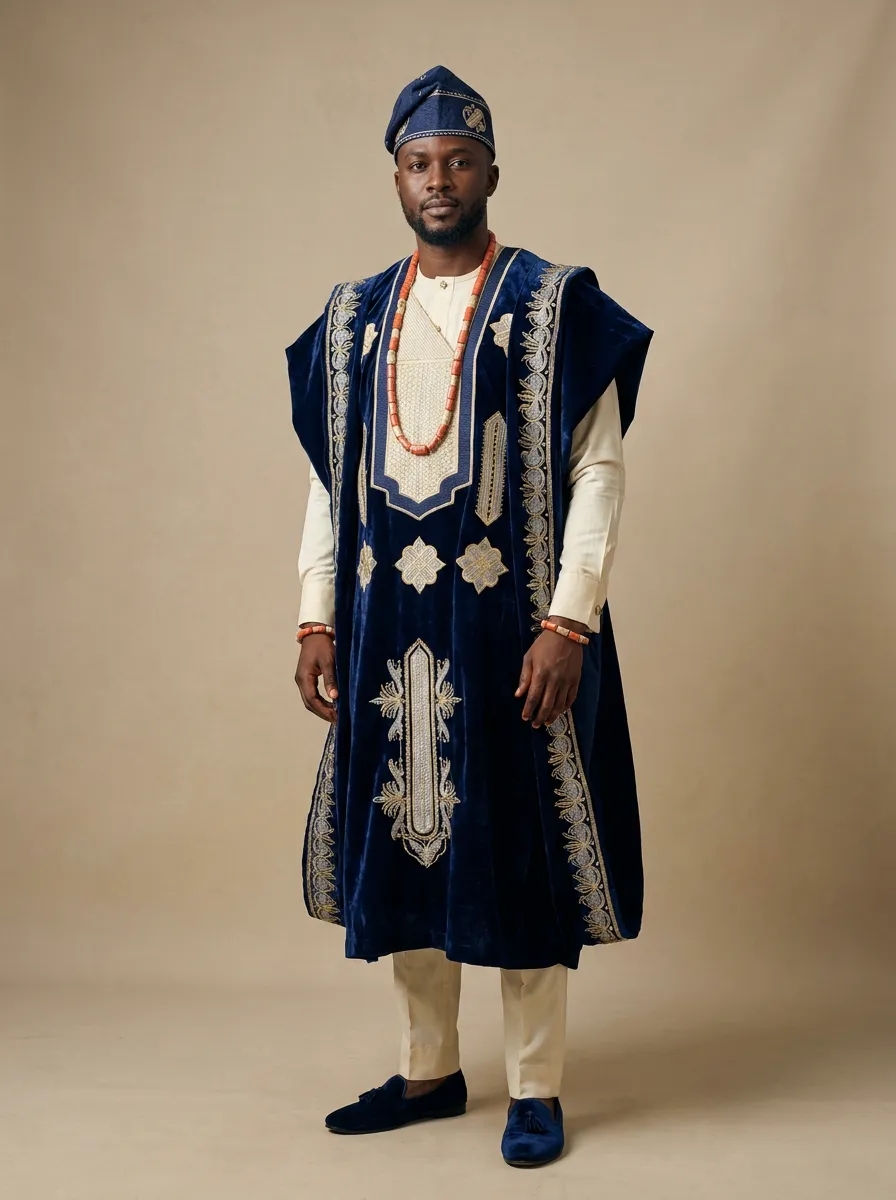
Agbada for a traditional wedding 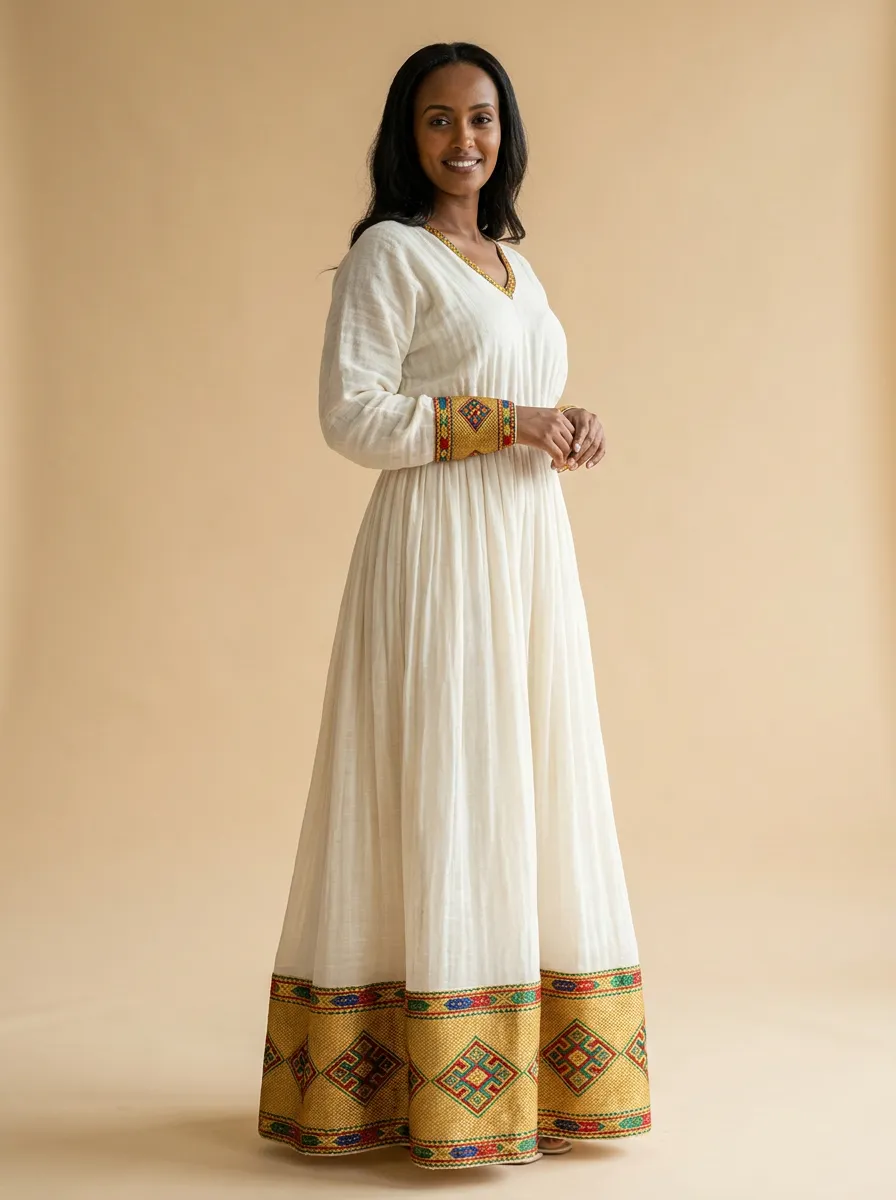
Habesha kemis, woven tibeb at the hem 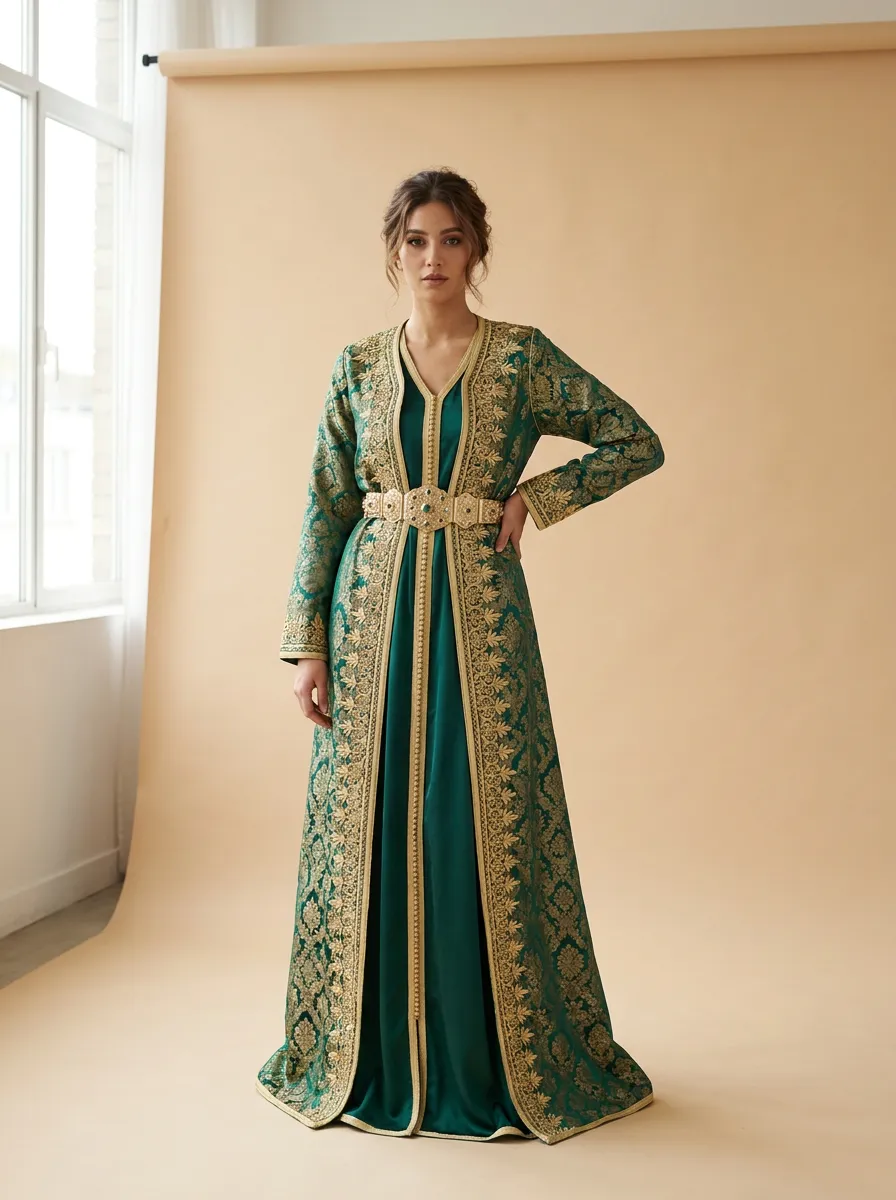
Takchita over its mdamma belt 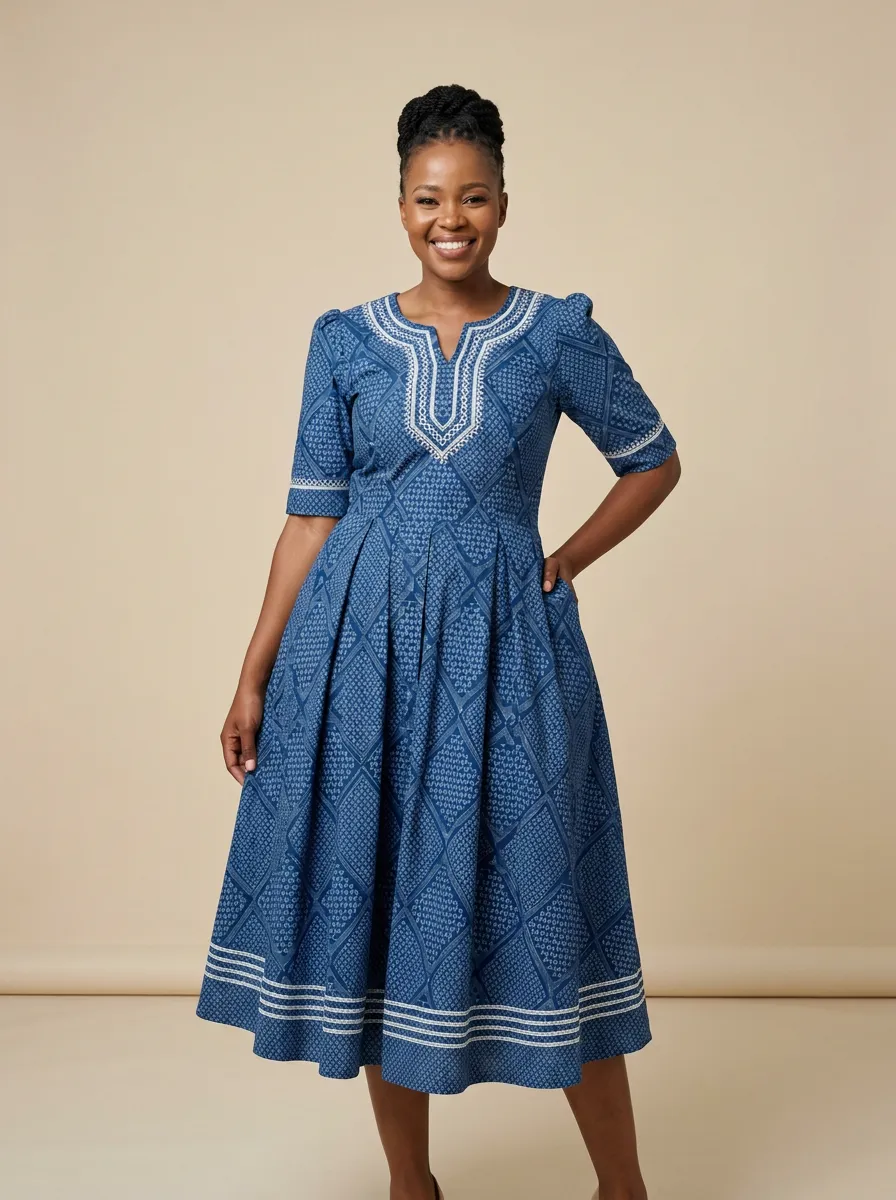
Shweshwe dress for a lobola
Renders this platform made and owns. Nothing borrowed: a marketing page showing a garment we did not make is a promise about output quality that the output did not make.
What comes out the other end
A sheet a workshop can cut from
Shape renders and sub-detail does not — a button-down collar comes back with the collar’s shape and without the buttons that make it one. So canvassing, pick stitching and lapel roll live on a written sheet instead, built only from what the record actually holds.
Nothing on it is inferred. A field the record does not hold arrives as blank and says so, because a missing fact costs a phone call and a fabricated one costs the garment.
A cost band, or none at all
Built from what the silhouette costs to make and how much labour each chosen craft adds — hand goldwork is not sequinning, and a loom-built cloth is not a print.
A silhouette nobody has costed produces no band, and the screen says so. The version of this that had a single fallback figure quoted a flip-flop and a bridal lehenga the same number.
The year you design against, not just the garment
A house does not design in a vacuum. It designs against a calendar — the festivals and occasions its customers dress for, and the shows and fairs its buyers plan around. ZZEESS holds that calendar, so you plan ahead of the window instead of chasing it after it has opened.
Every market’s occasions, computed forward
Diwali, Eid, Easter, a wedding season, a national day — each held by the rule that places it, so the date is right this year and every year rather than a list that quietly goes stale. Seven markets, each with its own calendar, because a Gulf season and a North American one are not the same year.
The shows and fairs, across the world
The major fashion weeks and trade shows, tagged to the markets they matter for, so a house knows what is coming in Paris, Lagos, Dubai or Mumbai and roughly when. It is curated and kept current, not a guaranteed live wire — a date is something to plan around and confirm before you commit to it, and the page says which are firm.
A reminder with lead time, and a plan to fill it
You are told weeks before a moment, not on the morning of it, so a collection is designed in time to be made. And the planner turns a market’s upcoming moments into a runway to work against — what the occasion asks for, what last year did, where your capacity and your gaps are. It plans; it is not a CRM or a sales desk, and it holds none of your customers’ data.
Your designs
The first question a house asks is what happens to its work. The short answer: isolation is enforced in the database rather than in application code, the shared part is the vocabulary and not your designs, and the one thing that crosses between tenants returns counts and taxonomy words with no tenant identity attached.
The limit
Registration is closed. Houses are brought on one at a time while the catalogue is finished, and there is no self-serve door behind any button on this page.
Makers and karigars: the workshop side of this is a separate conversation and a separate door. Write to us and say what you work in and where.
Why a house starts using it
The commercial case, argued in pictures and arithmetic: seven markets and 25 regions out of one vocabulary, the reach of that vocabulary as a multiplication you can check, everything a workshop is handed per design, and a place to put your own numbers in and see what a second market currently costs you.
No figure of ours appears on it. What a design costs your house is yours, and what this costs to use is agreed in the conversation that follows access rather than printed on a page.
Tell us what your house makes.
Which markets, which categories, which crafts, and what the first ten designs would need to be. That is enough for us to say whether this is useful to you yet — and to say so plainly if it is not.